![[Social Media Management] How a Two-Account Content Strategy Generated Nearly 300K Views for a Therapy Brand](https://kathlinvirtualassistant.com/wp-content/uploads/2026/08/case-study-for-a-therapy-brand.jpg)
Building a strong social media presence for a therapy practice requires more than posting mental health quotes or following trending topics. Because therapy is built heavily on trust, audiences need opportunities to understand not only what a practice offers, but also the people, perspectives, and values behind it.
This social media management case study looks at our work with VG Therapy Co, where we managed two Instagram accounts with different but complementary purposes:
Rather than treating both profiles as duplicates of one another, we developed content around the purpose and audience of each account. The business account focused more heavily on therapy education, services, relationships, mental health concerns, and building trust in the practice. The therapist-led account allowed us to explore a more personal and relatable style of content through professional perspectives, reflections, therapist experiences, and educational topics.
Over the reporting period, both accounts experienced substantial increases in visibility, engagement, and audience growth. But visibility alone doesn’t tell the full story. What made this campaign work was how that visibility translated into saves, shares, and a real connection between two very different but complementary online presences.
Our social media strategy focused on three things: consistency, audience relevance, and continuous optimization.
Rather than approaching social media as a matter of filling a content calendar, we wanted each post to serve a clear purpose within the broader marketing strategy. That meant understanding what audiences were responding to, testing different formats and topics, and adjusting the content direction based on actual performance.
One of the most important parts of the campaign was recognizing that @vgtherapyco and @thehopefulltherapist shouldn’t communicate in exactly the same way.
Although both accounts existed within the same broader brand ecosystem, audiences followed them for different reasons.
For @vgtherapyco, the strategy leaned more toward the practice itself. Content focused on areas such as:
For @thehopefulltherapist, we had greater flexibility to use the therapist’s voice and personality.
Content could be more reflective, relatable, personal, and conversational while still remaining professionally relevant. This included therapist perspectives, observations from working in mental health, emotional reflections, relatable therapy-related situations, and educational content delivered from a more personal point of view.
This distinction allowed the two accounts to complement one another instead of competing for the same content.
Organic growth requires repeated exposure. Instead of relying on occasional posts or waiting for a viral piece of content, we developed a consistent publishing system across feed posts, Reels, and Stories.
For @vgtherapyco alone, 983 pieces of content were published during the reporting period, including 134 posts, 36 Reels, and 813 Stories.
The account added 243 followers, representing a 656.76% increase from its starting point.
For @thehopefulltherapist, 968 pieces of content were published during the year while the account added 357 followers, representing 30.67% follower growth.
This consistent activity meant the brands weren’t simply appearing when there was something promotional to announce. They were continually educating, engaging, and staying visible to their audiences.
Mental health content performs best when people can recognize something meaningful in what they’re reading or watching.
Instead of relying heavily on generic motivational content, we developed topics around experiences the target audience could relate to.
This included relationship struggles, communication difficulties, emotional avoidance, trauma responses, burnout, stress, boundaries, and the experience of attending therapy itself.
Seasonal themes were also incorporated when they were relevant.
For example, during the early stages of the campaign, “Ways to Reduce Holiday Stress” became one of @vgtherapyco’s strongest-performing posts.
That same reporting period showed a 340.9% increase in content interactions compared with the previous month, giving us early evidence that relatable, actionable mental health content resonated with the audience.
The strategy became increasingly informed by these performance patterns throughout the year.
Posts, carousels, Reels, and Stories weren’t treated as interchangeable formats. Each served a different purpose.
Static posts and carousels gave us space to explain concepts, encourage saves, and communicate more reflective topics. Reels helped expand visibility and introduce more personality into both accounts. Stories maintained consistent contact with existing followers and provided a lower-pressure way to remain visible between feed posts.
For @vgtherapyco, feed content generated 29,049 post views and 2,390 interactions, including 1,621 likes, 298 comments, 238 saves, and 233 shares.
Reels contributed another 9,559 views and 653 interactions.
For @thehopefulltherapist, the scale was even larger.
Feed content generated 194,703 post views and 4,572 interactions. The account also recorded 2,814 likes, 381 comments, 517 saves, and 860 shares.
The high number of saves and shares was particularly useful because these actions indicate that audiences weren’t simply scrolling past the content. They were finding posts relevant enough to keep or send to someone else.
One of the advantages of managing both a business and personal brand account was the opportunity to use personality as part of the content strategy. This was particularly effective with @thehopefulltherapist.
Instead of making every post feel like formal educational material, some content could reflect what people might actually hear, think, or experience in relation to therapy.
For example, a Reel based around hearing a client say “I choose myself” generated 3,245 views, becoming one of the stronger-performing pieces reported later in the campaign.
Other successful themes used therapist humor, relatable observations, reflective thoughts, and common experiences from the therapy space.
This demonstrated an important difference between the two accounts.
@vgtherapyco helped build confidence in the practice.
@thehopefulltherapist helped audiences connect with the person and perspective behind the practice.
Together, the accounts created multiple ways for potential clients and followers to engage with the brand.
We regularly reviewed metrics across both accounts, including content views, reach, likes, comments, saves, shares, followers, profile visits, link clicks, content interactions, and Reel performance.
Not every metric increased every month, and that’s an important part of organic social media management. There were months when engagement or profile visits declined while other indicators, such as reach or link activity, improved. Instead of reacting to one month’s numbers in isolation, we looked at longer-term patterns.
This allowed us to identify which topics consistently attracted attention, which formats generated meaningful engagement, and how audience behavior differed between the two profiles. That data informed the next stage of the content strategy.
After a year of consistent social media management, both accounts had developed significantly stronger online visibility, engagement, and audience trust, not just higher view counts.
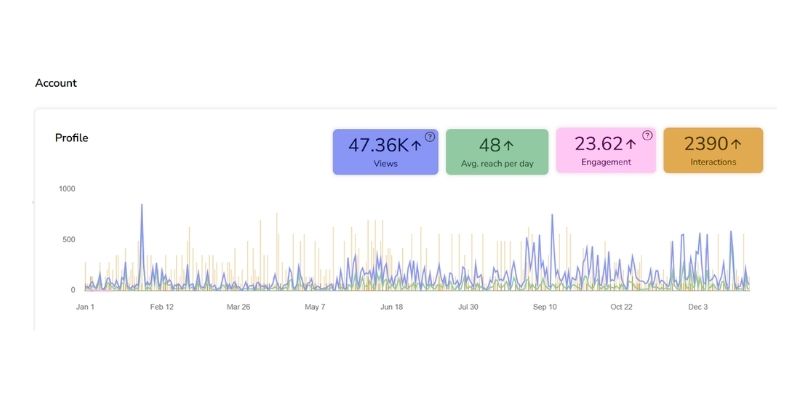
The practice account recorded:
The account evolved from having relatively limited social visibility into a consistent channel for educating audiences and increasing awareness of VG Therapy Co.
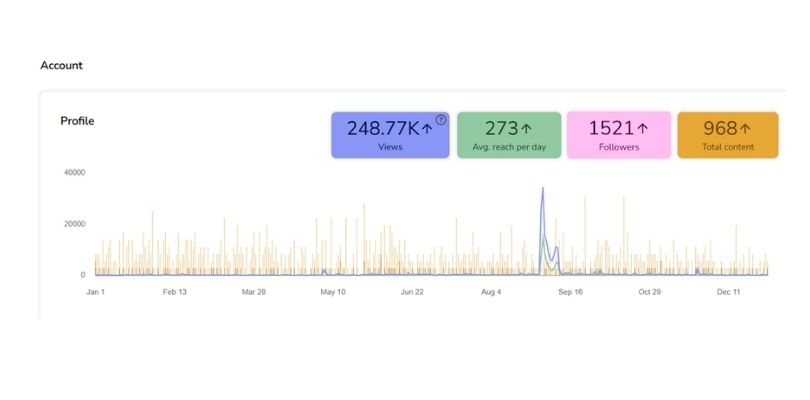
The therapist-led account recorded:
Reels also became an important visibility driver. The annual report recorded 23,768 Reel views, along with 1,112 likes, 148 comments, 124 saves, and 88 shares from Reel content.
The scale of the growth was particularly significant because the account already had a larger existing audience. Rather than starting from a very small follower base, the strategy increased visibility substantially while continuing to grow an established personal brand, and the interaction and reach numbers confirm that growth wasn’t just algorithmic noise, but audiences actually engaging with the content.
One of the biggest lessons from the VG Therapy Co campaign is that businesses don’t necessarily need every social account to perform the same function.
In this case, the two accounts supported different stages of audience familiarity.
@thehopefulltherapist provided a more personal entry point.
People could discover relatable mental health content, therapist observations, reflections, and personality-driven Reels without immediately feeling as though they were being marketed to.
@vgtherapyco, meanwhile, provided a clearer connection to the practice, its expertise, therapy-related education, and professional services.
Someone could discover the therapist first and later become familiar with the practice — or discover the practice and then connect more deeply through the therapist’s personal content.
This created a broader organic ecosystem than relying on a single business account alone.
The VG Therapy Co campaign demonstrates why social media management shouldn’t be judged solely by follower count.
Across the two Instagram accounts, our strategy helped generate nearly 300,000 account views, thousands of meaningful interactions, hundreds of new followers, and considerably stronger overall reach.
But the more important result was what those numbers represented.
The brand created a consistent presence where audiences could repeatedly encounter helpful information, relatable perspectives, professional expertise, and the personalities behind the therapy practice.
Rather than depending on viral trends or aggressive promotional content, growth came from consistent publishing, audience-led content, format experimentation, performance analysis, and distinct strategies for the business and personal brand accounts.
For service-based businesses, this is where organic social media becomes valuable. It’s no longer simply a place to post updates. It becomes a long-term channel for building visibility, familiarity, trust, and connection with the people the business wants to reach.
If your social media accounts are active but aren’t building meaningful visibility or engagement, book a discovery call so we can discuss how a structured organic social media strategy can strengthen your brand’s online presence.