
If you are comparing GoHighLevel vs HubSpot, you will quickly notice that both platforms promise a lot.
CRM. Email marketing. Automation. Sales pipelines. Landing pages. Lead management. Reporting.
AI tools. At first glance, they seem to compete for the same customer.
They can. I’ve worked with both types of systems, and I see the biggest difference in who gets the most out of them.
GoHighLevel tends to fit SMEs, service businesses, and agencies well.
HubSpot tends to make more sense as sales and marketing operations become larger and more complex.
Both can serve businesses outside those groups. HubSpot has plans for small businesses, and HighLevel now has an Enterprise plan too.
So your company size alone shouldn’t decide this.
Your workflows should.
GoHighLevel, often shortened to GHL or HighLevel, combines many tools that a freelance marketing professional, service business or marketing agency normally has to purchase separately.
HighLevel currently lists features including:
For an agency, HighLevel’s account structure is one of its strongest features.
You can give each client a separate sub-account with its own contacts, funnels, workflows, calendars, domains, emails, phone setup, and other settings.
I find that useful because client systems stay separated without forcing you to manage a completely different platform for every account.
HighLevel currently lists its Starter plan at $97 per month, Unlimited at $297, and Agency Pro at $497. Starter includes three sub-accounts. Unlimited includes unlimited sub-accounts. Agency Pro adds SaaS features and more agency controls.
Usage fees still apply to things such as email, phone, SMS, and some AI products.
So the monthly subscription isn’t always your full bill.
HubSpot has grown far beyond a simple CRM. It has been around much longer and has grown into a large customer platform covering marketing, sales, customer service, content, operations, commerce, and CRM.
The CRM sits at the centre of that setup.
HubSpot gives businesses more room to structure complicated relationships between connects marketing, sales, customer service, content, data, revenue operations and AI tools around its CRM. HubSpot also maintains an ecosystem of more than 2,000 apps and web services.
That becomes useful when your sales process has several teams, territories, products, account owners, pipelines, reporting requirements, or approval processes.
And this is where I think HubSpot earns a lot of its reputation. Think about a business with:
That is where HubSpot starts becoming very attractive. Its CRM structure is deeper. Its reporting is stronger. For a company running a long list of software across sales, service, finance, marketing, and operations, that can make the CRM easier to fit into an existing stack.
This is also why simply calling HubSpot “expensive HighLevel” misses the point. The two platforms are solving some of the same problems at different levels of operational complexity.
| Category | GoHighLevel | Hubspot |
|---|---|---|
| Best Fit | SMEs, agencies, service businesses, coaches, appointment-based businesses | Growing companies, mid-market teams, and enterprises |
| CRM | Contact and pipeline focused | Deeper CRM structure and relationships |
| Marketing automation | Strong email, SMS, calling, and workflow options | Strong CRM-based marketing and sales automation |
| Funnels | Built into the platform | Landing pages and campaign tools available through HubSpot products |
| Websites | Website and funnel builder included | More developed CMS and content tools |
| Email Marketing | Built into workflows and campaigns | Strong email, segmentation, and campaign management |
| SMS and calling | Closely built into the platform | Available through HubSpot products, add-ons, and integrations |
| Calendar Booking Appointment scheduling | Built in | Built in |
| Reputation management | Built in | Usually handled through integrations or other tools |
| Agency Accounts | Sub-accounts are a core part of the platform | Agencies usually manage separate HubSpot portals |
| White-label options | Available for agencies | Limited compared with HighLevel |
| Reporting | Covers common SME and agency needs | Better suited to complex reporting and revenue operations |
| Integrations | Growing marketplace | Much larger app ecosystem |
| Pricing | Platform plans plus usage costs and add-ons. With 14-day free trial. | Free tools, then pricing by products, seats, contacts, and tier |
For many SMEs, CRM requirements are fairly practical. You want to know:
HighLevel handles this kind of sales process well. A contact can submit a form, enter a workflow, receive an email or SMS, appear in a pipeline, book through a calendar, and trigger another workflow after the appointment.
All of that can happen inside one account. For service businesses, I like that setup.
A plumber probably doesn’t need an elaborate company hierarchy inside the CRM. They need to know that John requested a quote, Sarah called him, he booked for Thursday, and the job is now worth $2,400.
HubSpot gives you more depth once those relationships become complicated. A B2B company might have one company record connected to several contacts, multiple deals, decision makers, account managers, tickets, and other records.
HighLevel has added custom objects and keeps expanding its CRM features, but HubSpot still has more maturity in this area.
For a five-person service business, some of that depth may sit unused.
For a 500-person company, it can become part of everyday operations.
I use GHL workflows for my business, and this is probably one of my favorite parts of the platform.
You can trigger workflows from things such as:
Then you can combine email, SMS, internal notifications, pipeline actions, delays, conditional branches, and other steps.
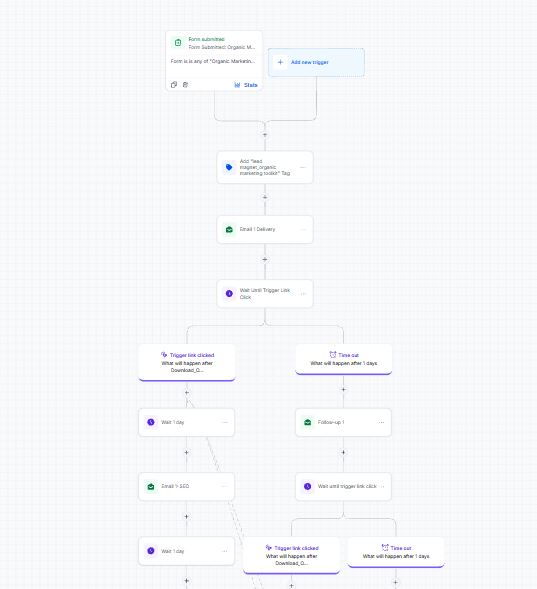
For example, I can set up a lead magnet where someone submits a form, gets tagged based on their answer, receives a specific email sequence, and gets moved into another workflow later. I don’t have to connect five different apps to make that happen.
HubSpot has strong workflow tools too, especially when automation needs to react to deeper CRM relationships.
A company can trigger processes based on contact records, company records, deals, tickets, and other connected information.
So I tend to look at automation complexity.
For common lead nurturing, booking, follow-up, re-engagement, and pipeline automation, HighLevel gives SMEs a lot to work with.
For a company with several departments sharing complicated CRM data, HubSpot gives the team more control.
HighLevel makes sense to me when a business gets most of its leads through landing pages, forms, appointments, and follow-up.
You could run something like:
Facebook ad → landing page → form → workflow → calendar → pipeline → follow-up
And keep almost everything inside HighLevel.
Its funnel builder connects directly with forms, calendars, workflows, products, and CRM records.
HubSpot has landing pages, forms, CTAs, email marketing, content tools, advertising features, and automation too.
Its roots in inbound marketing still show. For companies publishing large amounts of content, managing SEO campaigns, running several marketing channels, and tracking how those activities contribute to revenue, HubSpot gives the marketing team more depth.
For a local service company running ads and trying to turn enquiries into booked appointments, HighLevel usually gives me enough.
And usually at a much easier price to defend.
This is where HighLevel makes the most sense to me. Its whole account structure works around agencies.
An agency account can contain separate client sub-accounts. Each client gets its own CRM data, domains, funnels, calendars, workflows, forms, users, and settings.
You can also clone systems between accounts using snapshots. So if you’ve built a working setup for dentists, for example, you can package parts of that setup and deploy it to another dental client.
Agency Pro goes further with SaaS features and white-label options.
At $497 per month, the SaaS Pro plan is aimed at agencies that want to package HighLevel as part of their own service or software offer. You can create client accounts, apply your own branding, automate account creation, and charge clients for access to the platform.
If that’s the direction you’re taking your agency, HighLevel currently offers a 14-day trial for the SaaS Pro plan.
Try HighLevel SaaS Pro for 14 days.
HubSpot has a large partner community and plenty of agencies specialize in HubSpot implementations. The setup works differently. Clients normally have their own HubSpot portal, and the agency works inside that account.
For agencies serving mid-market or enterprise clients, that model can make sense.
For agencies serving dozens of smaller service businesses, HighLevel’s sub-account structure is easier for me to manage.
HubSpot usually feels cleaner when you first open it. Menus tend to be easier to understand, and the product has had years to refine how everything fits together.
HighLevel takes more time. You have agency-level settings. Then sub-account settings. Then settings for email, phone numbers, domains, calendars, workflows, funnels, users, payments, integrations, and several other areas.
It can feel like someone handed you the keys to 15 pieces of software at once. Once you understand how the system connects, though, managing client marketing from one place becomes much easier.
When I set up HighLevel for a business, I prefer starting with the customer journey:
Lead capture → follow-up → booking or sales conversation → pipeline → customer
Then I add what the business actually uses.
Turning on every feature because it’s there is a very quick way to create a CRM nobody wants to touch.
If you’re planning to use HighLevel professionally, especially for client work, its certification program is also worth looking at. I like structured training for platforms like this because there are a lot of settings you can easily miss when you’re learning through trial and error.
Price is probably where the difference becomes obvious fastest.
HighLevel currently lists:
HubSpot’s current Marketing Hub pricing starts at:
At first glance, HighLevel’s $97 Starter plan looks expensive next to HubSpot’s $10 Starter plan.
The two Starter plans cover very different amounts of software.
HubSpot Starter is priced per seat and includes 1,000 marketing contacts, basic email marketing, forms, ad tools, CRM segmentation, and simple marketing automation. HubSpot currently limits Starter email automation to 10 automated actions.
HighLevel Starter is closer to a bundled marketing and sales system.
For $97 per month, you get unlimited users and contacts, plus access to tools such as CRM, pipelines, workflows, funnels, website building, calendars, email marketing, SMS functionality, reputation management, payments, and up to three sub-accounts.
So if you’re comparing the entry prices alone, HubSpot wins easily.
But your actual software stack is the better comparison.
A service business using HubSpot Starter may still need separate tools for more advanced automation, SMS, funnels, reputation management, or other functions that HighLevel already puts inside the same account.
And HubSpot pricing changes quickly once you need more than the Starter limits.
Marketing Hub Professional currently jumps to $890 per month and includes three Core Seats, 2,000 marketing contacts, advanced automation, social media tools, lead scoring, and custom reporting. There’s also a required $3,000 Professional onboarding fee.
Enterprise starts at $3,600 per month, with five Core Seats and 10,000 marketing contacts. HubSpot also lists a required $7,000 Enterprise onboarding fee.
HighLevel’s pricing has its own extra costs.
You can still rack up charges through email, SMS, phone, AI tools, WhatsApp, and other usage-based services depending on what you use.
So I wouldn’t compare $10 HubSpot against $97 HighLevel and stop there.
For a solo business that only needs basic CRM and email marketing, HubSpot Starter can be cheaper.
For a service business that already needs CRM, funnels, booking, automation, email, SMS, and pipeline management, HighLevel’s $97 starts making more sense because you’re paying for a broader set of tools from day one.
For agencies, the pricing difference becomes even more noticeable.
HighLevel’s Unlimited and Agency Pro plans are built around managing multiple client sub-accounts. HubSpot charges around its own product tiers, seats, marketing contacts, and account requirements, so the cost can climb much faster when you’re managing several businesses.
This is also something that comes up in user discussions.
In one Reddit thread comparing the two platforms, several users praised HighLevel’s cost-to-feature ratio. One user also described it as less polished in some areas, which matches a common criticism of the platform.
I think that’s fair.
HighLevel sometimes feels like a platform that’s shipping features faster than its interface can catch up with them.
I’d lean toward HubSpot when a business has:
One technical comparison I reviewed reached a similar conclusion.
It found HubSpot stronger in data modelling, enterprise reporting, integrations, governance, and compliance, with HighLevel stronger in agency economics, multi-client accounts, and white-label use.
That matches how I see the two platforms in actual business use.
I’d look closely at HighLevel if you run:
HighLevel gives these businesses a lot inside one account.
CRM. Forms. Calendars. Funnels. Email and SMS. Pipelines. Automations. Reviews. Payments.
For an SME, reducing the number of separate tools can make both the setup and the monthly software bill easier to manage.
Competitor comparisons tend to reach a similar conclusion. Perspective, for example, positions HighLevel around agency and client management and HubSpot around larger in-house CRM, marketing, and sales operations.
For an SME or service-based business, I’d usually start by evaluating GoHighLevel. You can run a lot of the customer journey inside one platform, and the pricing makes sense for businesses that would otherwise pay for several separate tools.
For a larger company with complicated sales relationships, several departments, detailed reporting requirements, and a large integration stack, I’d look harder at HubSpot.
And for agencies, I lean toward HighLevel unless the agency specifically serves clients already committed to HubSpot.
The deciding factor is how your business actually works.
Pick the system your team can actually run every week.
A CRM with 300 impressive features is still pretty useless if everyone keeps their leads in a Google Sheet.
For agencies and many service-based SMEs, I often prefer GoHighLevel because CRM, funnels, booking, email, SMS, and workflows sit inside the same platform. HubSpot makes more sense for companies with deeper CRM, reporting, integration, and governance requirements.
Yes. The Starter plan currently costs $97 per month and includes unlimited contacts and users with up to three sub-accounts. Service businesses that rely on enquiries, appointments, follow-up, and pipelines are especially well suited to the platform.
HubSpot serves small businesses too. It has free CRM tools and paid Starter products, so smaller teams can use HubSpot without buying an enterprise setup. Its Professional and Enterprise products become more relevant as operations get more complicated.
Yes. Agency use is one of HighLevel’s main strengths. Its account structure lets you manage separate client sub-accounts from one agency dashboard, and higher plans include tools such as snapshots, white-label options, and SaaS Mode.
For some businesses, yes. An agency or service company with common CRM, booking, funnel, and automation requirements may be able to run most of its sales and marketing through HighLevel. Companies using HubSpot for complex data relationships, enterprise reporting, or advanced operations would need to compare those requirements carefully before switching.
HighLevel starts at $97 per month, with additional usage costs depending on services such as email, SMS, phone, and AI. HubSpot starts with free tools, then pricing increases based on the products, tiers, seats, marketing contacts, and features you choose. For agencies managing several client accounts, HighLevel’s pricing structure is usually easier to work with.