

The main purpose of using keywords in SEO is simple: they connect what your audience is searching for with the content you create. When you understand exactly which words and phrases your potential clients type into Google, you can build pages that show up at the right moment, in front of the right people, for the right reasons. In practice, keywords help you rank and help the right people find you.
A business with no keyword strategy is essentially invisible online, no matter how good the work is.
Keyword research in 2026 looks different from what it did even two years ago. AI Overviews now occupy the top of search results, video content appears inside traditional SERPs, and search intent has become more important than raw search volume. Getting keyword research right means accounting for all of it, not just pulling a list of terms from a tool and calling it done.
Keyword research is the process of identifying the words and phrases your target audience uses when searching for information, products, or services online, and then strategically using those terms in your content so search engines can match your pages to those queries.
When used properly, in your headings, opening paragraphs, meta title, URL, and naturally throughout the body, keywords help search engines like Google understand the topic of your page, which determines when and where it appears in search results. Over time, consistently targeting a keyword cluster builds topical authority, which lifts your rankings across all related terms. The right keywords get you in front of people who are already looking for exactly what you offer.
The main benefits of keyword research for businesses:
Delivers compounding ROI: organic rankings keep working without ongoing spend
If you’re still approaching keyword research the same way you did in 2022, you’re leaving opportunities on the table. Here’s what’s changed.
Google’s search results in 2026 are more layered than ever. AI Overviews now pull direct answers to the top of many queries, reducing click-through on informational content. Short-form video results, Reddit threads, image packs, and People Also Ask boxes now compete for screen space alongside traditional page rankings.
What this means for your keyword research: you can no longer assume what type of content will rank for a given keyword without checking the live SERP first. A keyword that appears bloggable might actually be dominated by YouTube videos, and your written post won’t get the visibility you’re expecting.
One of the most significant shifts in 2026 is that keyword research now applies to content across multiple formats. YouTube has overtaken Reddit as a citation source for AI-generated answers, which means video content is now being surfaced in both traditional SERPs and AI search results. TikTok and Instagram Reels are also appearing in short-form video tabs for relevant keywords.
When you research a keyword cluster now, you should be asking: does this topic warrant a blog post, a YouTube video, a short-form video, or all three? The SERP will often tell you.
Search volume is still a useful signal, but it is not the right starting point. A keyword with 10,000 monthly searches is worthless if the people searching it are not your potential clients. In 2026, the best keyword research strategy begins with intent. You want to understand what the searcher actually wants to do, and then validate with volume and difficulty data.
A keyword research strategy is a systematic approach to finding, evaluating, and prioritizing the keywords you want your website to rank for. It goes beyond generating a list of terms. It includes defining your business goal, understanding search intent, assessing your competitive position, grouping keywords into topic clusters, and mapping them to a content plan. A strategy is what turns keyword data into actual results.
Before you open any keyword tool, you need that strategy. Otherwise you’ll end up with a list of terms that look good on paper but don’t connect to your actual business goals.
Are you trying to grow organic traffic, generate leads, rank for your service offers, or build authority in your niche? Your goal shapes which keywords are actually worth targeting.
How does your target client describe their problem? They’re probably not searching ‘organic marketing strategy.’ They might be searching ‘how to get more clients without ads’ or ‘grow my business without social media.’ The closer your keyword list is to your audience’s actual language, the better.
Map keywords to your funnel stages
You don’t need to spend a fortune to do keyword research effectively. A combination of free and affordable tools covers most use cases:
Follow these seven steps in order. Each one builds on the previous, so skipping ahead tends to create problems later.
Seed keywords are the broad, foundational terms that describe your topic or service. They are your starting point for keyword discovery, not necessarily the terms you will target directly.
To generate seed keywords, start by listing your core services and topics. Then think about how your clients describe their problems. Finally, look at what language competitors use on their service pages and blog content.
Examples of seed keywords for an organic marketing specialist: ‘SEO,’ ‘keyword research,’ ‘content marketing,’ ‘organic traffic,’ ‘social media marketing.’
Take your seed keywords into a tool like SE Ranking’s Keyword Research, Ahrefs Keywords Explorer, or Google Keyword Planner. From each seed, you’ll surface hundreds of related keyword variations.
As you expand your list, capture these data points for each keyword: search volume (monthly searches), keyword difficulty (how hard it is to rank), CPC or cost-per-click (a high CPC signals strong commercial intent), and search trend direction (is this keyword growing or declining?).
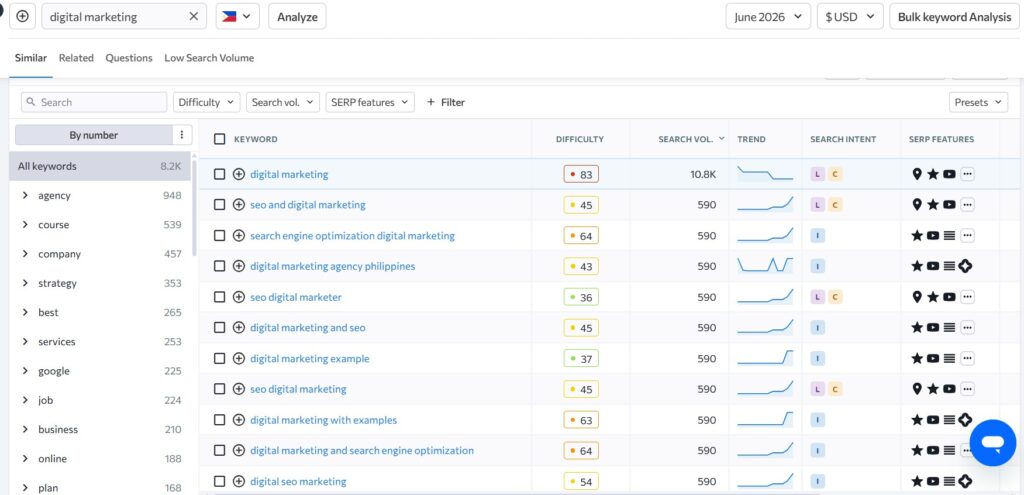
Pay particular attention to the difference between short-tail and long-tail keywords. Short-tail keywords are broad, typically one to two words, with high search volume and high competition (e.g., ‘keyword research’). Long-tail keywords are more specific phrases of three or more words, with lower volume, lower competition, and higher purchase intent (e.g., ‘how to do keyword research for a service business‘). For most service businesses, long-tail keywords are easier to rank for and drive more qualified leads. A keyword searched 50 times a month that targets someone actively looking to hire will often convert better than a keyword with 5,000 monthly searches and mixed intent.
For every keyword on your list, classify the search intent: informational (the person wants to learn something), navigational (they’re looking for a specific site or brand), commercial (they’re researching options before making a decision), or transactional (they’re ready to act or buy).
Then cross-check with the live SERP. Search the keyword in an incognito browser and look at what’s ranking. If Google is serving listicles and how-to guides, the intent is informational. If it’s serving product or service pages, the intent is commercial or transactional. If it’s serving YouTube videos, you may need to create video content to compete. Match your content format to what the SERP is already rewarding.
A high keyword difficulty score doesn’t automatically rule a keyword out, but it does mean you need to be realistic about your current domain authority (DA). A new website competing for a KD 80 keyword against established publications isn’t a smart use of resources.
Instead, identify the gap keywords: terms with moderate volume, manageable difficulty, and strong intent that you could realistically rank for within 6 to 12 months. These become your priority targets while you build authority over time. A keyword gap analysis, where you compare your rankings against a competitor’s, is one of the fastest ways to find these opportunities.
Modern SEO is about building topical authority by covering a subject comprehensively. This is the topic cluster model: a pillar page covers a broad topic in depth, supported by cluster pages that target related subtopics and long-tail variations.
Group your keyword list by theme, not just by term. Keywords that share the same search intent and topic can often be targeted together on a single page. Aim for one page per cluster rather than one page per keyword.
Organize your clusters by priority: which have the highest commercial value, the most attainable difficulty, and the clearest fit with your services?
Before briefing or writing any piece of content, do a manual SERP check on your target keyword. Look at the top five results: What format are they? How long are they? What questions do they answer? What’s missing that you could cover better?
Check the ‘People Also Ask’ box. These are actual questions your audience is searching, and answering them in your content increases your chances of appearing in that feature. Check the ‘Related Searches’ at the bottom of the page for additional keyword variations to incorporate.
If AI Overviews are present, look at what sources they cite and what format the answers take. This tells you what Google currently considers authoritative on this topic.
Before creating any new content, audit what you already have. You may have existing pages that rank on page two or three for your target keywords. Those are often faster wins to update and optimize than starting from scratch. Assign each keyword cluster to either an existing page (update and optimize) or a new page (create). Each page should have one primary keyword, two to four supporting secondary keywords, and a clear topical focus. Use your keyword map to build or update your content calendar, prioritized by commercial relevance and attainability.
For a single page or blog post, expect to spend one to three hours on thorough keyword research. A full content strategy for a new website can take several days. The timeline depends on your niche’s competitiveness, the tools you’re using, and your experience level. If keyword research consistently slows down your content production, working with an SEO specialist is often the more efficient choice. Keyword research done right shapes your entire content strategy, and getting it wrong means writing content that never ranks.
| Scope | Estimated Time | What’s Included |
|---|---|---|
| Single page or blog post | 1-3 hours | Seed keywords, SERP check, intent analysis, competitor review |
| Service page optimization | 2-4 hours | Competitor keyword gaps, intent mapping, cluster grouping |
| Full content strategy (new site) | 2-5 days | Full list expansion, gap analysis, topic clustering, content calendar |
| Ongoing quarterly review | 3-6 hours/quarter | Rank tracking review, new opportunities, content refresh prioritization |
What most affects your timeline: industry competitiveness, the size of your site, access to paid tools, and how much SEO experience you have going in.
These keyword research tips apply whether you’re doing this for a single blog post or building an entire content strategy from scratch.
SEO keyword research is the foundation of every content decision you make. When you get it right, every blog post, service page, and piece of content you create has a clear purpose: to attract the right audience and move them closer to working with you.
Use the step-by-step process in this guide, save the checklist, and revisit your keyword strategy every quarter as SERPs continue to evolve. If you’d prefer a keyword strategy built specifically around your business and services, I can help with that.
Want an SEO strategy built around your business?
I offer done-for-you keyword research and SEO services for service businesses that want to grow organically and without the guesswork.